Related Artists
Pasha Petrosyan of Flash Flash Comfort talks beating perfectionism, building momentum in Chicago’s DIY scene
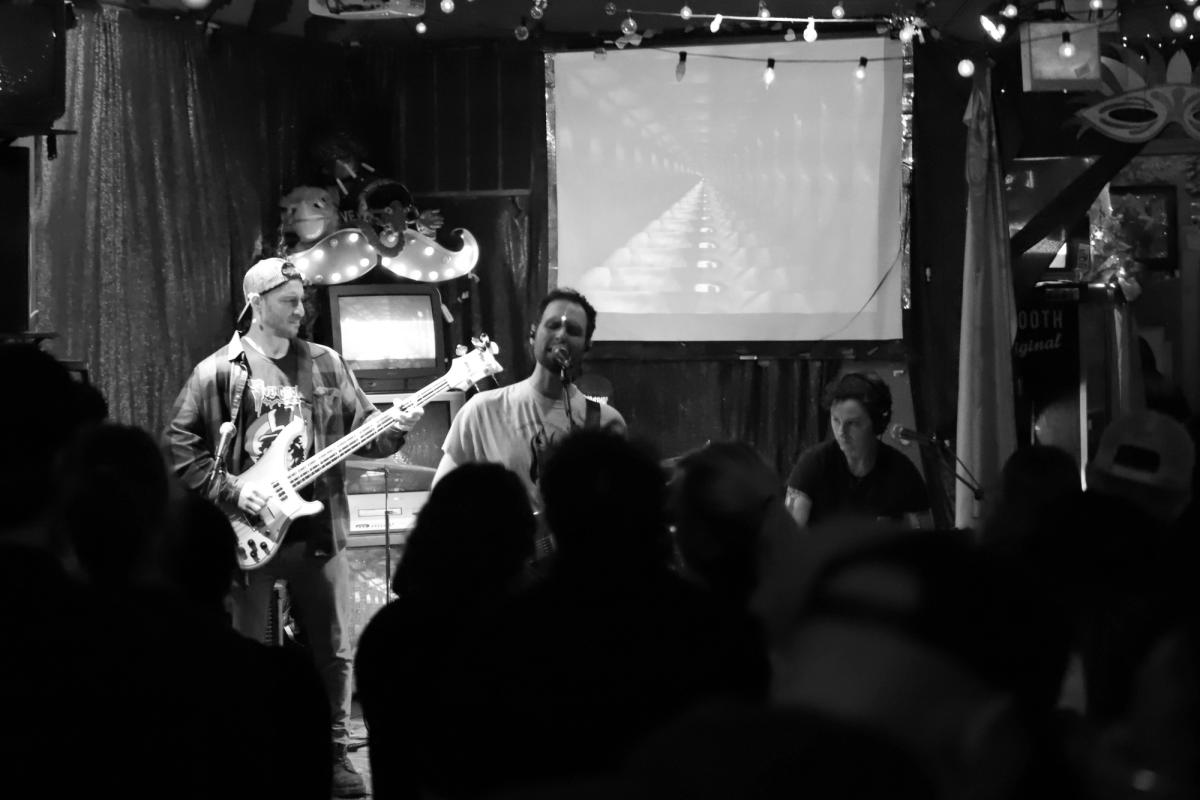
Catch Petrosyan’s Flash Flash Comfort next at Not Not on Friday, May 8 (8pm), or at Reggies on Thursday, June 18 (8pm), where the band will join a high-energy alternative-rock bill alongside King Falcon and Cinema Stereo. More dates here.
Avondale-based multi-instrumentalist Pasha Petrosyan spent their youth in Moscow and Kyiv before immigrating to the Chicago suburbs at age 11. The experimental soundwork they developed as a teen became the backbone of Flash Flash Comfort, a psych/post-punk project they formed after moving to Chicago in 2013. Since then, Petrosyan’s catalog has grown into a genre-blurring mix spanning ’90s Euro club textures and industrial pop.
Now, with a sophomore album set for recording this May (title still under wraps), Flash Flash is building momentum once again. Upcoming shows include May 8 at Not Not and June 18 at Reggies Chicago, where they’ll join King Falcon and Cinema Stereo.
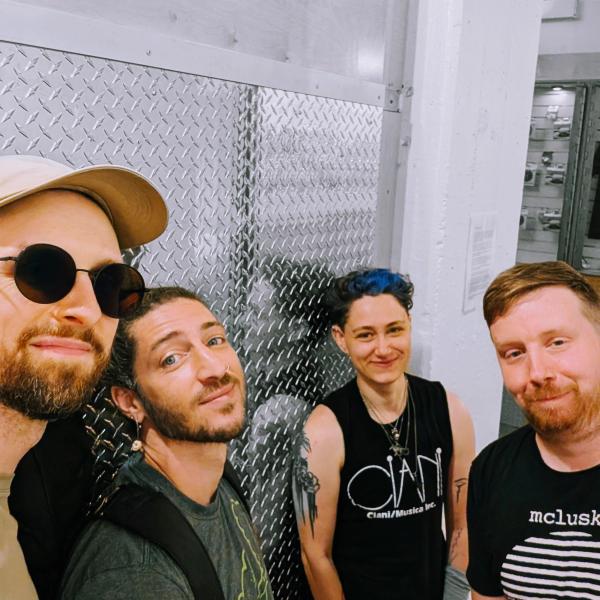
The band’s current resurgence follows an earlier run that yielded the debut album Chill Night (2016) and the EP Reverse Resolution (2018). In 2025, the project reemerged as Flash Flash 2.0—now featuring Al Kolot (synths), Luke MacRoberts (bass), and Ben Karas (drums)—and quickly found its footing across Chicago’s DIY and small-room circuit, from Psych Night at Café Mustache to CHIRP Radio’s monthly showcase at The Whistler.
Below, Lee Jones of Esox Media revisits a recent conversation with Petrosyan on generating creative momentum, letting go of perfectionism, and finding one’s voice.
Editor’s note: I had an early listen to Flash Flash’s forthcoming album. It’s a half-as-loud, twice-as-sure record—cool-headed and world-weary on the surface, dry and sardonic, with a masked urgency and low-slung jazz drift threading through its slow-burn prog edges. Underneath, though, it runs hot: resolute, self-assured, a little daredevil, a little gutsy. The album channels the depth and quiet hope of Chicago’s underground—artists moving in parallel, suspended in temporary holding patterns, alone yet together, each guided by their own internal glow.
. . .
Q: If you trace it back, what first pulled you toward music—was it something you grew up around?
A: We moved to the States when I was 11. I had no contacts with anyone. Once I’d realized how isolating it was living in the [Chicago] suburbs as an immigrant kid with a thick Russian accent, I really dove into it, music as an escape.
No one in my family had pursued music in any meaningful way except my one uncle who was a famous cellist in Soviet Russia. Well, “famous” in the way that my dad has a photo of him on the wall and my family is proud to have him in our tree. [Laughs.] My twin sister is naturally a better singer than I am, although she doesn’t sing much these days as far as I know. She is a visual artist, so definitely creative. It’s funny that I’m the one who ended up singing.
My dad played some guitar but he was primarily an electrical engineer. He learned how to make guitar pedals and helped people fix their amps and guitars back in Russia when there were not a lot of resources. He actually made the guitar I play right now, and my distortion pedal. In my teens, he would compose stuff on his computer using this very rudimentary music software that existed back then. They were these little, eerie compositions, not classical, but using classical instruments.
Once I found my dad’s archaic computer software, I started making weird electronic music by myself and sharing it with some people, and getting more into bands, and meeting other people who played music. I quickly realized I was more interested in playing my own music than playing covers. One of my first collaborators was the kid who I gave some of my dumb electronic songs that I was making at home. We ended up starting a project that actually lasted about 10 years. There has been no looking back.
In my experience, anything that happens for me has primarily been by my own volition. I’ve had to put my stuff out there. I kind of take the same approach with the DIY scene in Chicago—unless you make moves and you advocate for yourself, you are generally not going to see a lot of movement with your project. So that’s been my ethos, kind of just ‘make shit happen’. The event-curation part is just an extension of that.
Q: What’s your vocal journey been like as Flash Flash Comfort’s lead vocalist?
A: I am very much self-taught. I didn’t sing for the first few years—I just played instrumental music with my friends and we’d have someone else on vocals. It took a long time before I felt comfortable singing. I still remember to this day when I sang for the vocal teacher at school back in Russia. He said, ‘That’s not singing, that’s talking.’ I thought, ‘Oh no, I’m cooked!’ That sat with me for a while. It’s really funny how negativity bias is so built into us.
As far as my vocal journey, I just started nerding out about different singers that I liked. The people who really blew my mind open and were challenging in terms of their sounds were Björk, Thom Yorke, and Morrissey. I was most interested in the nuances that they exhibited through their vocals, and how much voice can carry feeling. I think my favorite singers are the ones where you can just tell there’s something underneath the song, where it’s not just a performance but there is very real vulnerability. Also, fuck Morrissey, but goddamnit, he was really good back in the day.
I feel like I’ve had a few breakthroughs from the 2010s until now, in terms of learning exactly how much pressure to exert on my vocal chords, how much air to push, and how to internalize diaphragmic breathing and really make that part of my singing when I’m performing. Also, just having that experience of doing it for a while helps you kind of know the limits of your vocal chords and where you’re going to start tensing up.
Q: As the curator behind Psychic Harvest at Bric-a-Brac Records and Psych Night at Café Mustache, how do you approach building a lineup?
A: It’s kind of like the analogy of going to a restaurant and getting a multicourse meal. When I have an opportunity to put bills together, I think about what I’d want to see if I were going to the show. Some promoters will throw bills together just in a wacky, nonsensical way that is not very creative: ‘Oh, this band is shoegaze-y, I’ll just put some other shoegaze-y band with it.’
For Psychic Harvest, I was trying to think objectively about the intensity of the music and what would and would not go with our vibe. I thought of Swim Ignorant Fire, which made some really cool transcendental ambient music and which feels like a psych band to me even though they might not consider themselves that. Then I asked another friend, Sean [McCormick] from Blush Scars, a heavier band—heavier than us—kind of rockabilly-influenced post-punk. I was like, OK, this is the bill. We worked out that Blush Scars would start out heavy and fast and Flash Flash would go second because we span both areas—we do get more chill, but we also have some pretty heavy songs—and then we’d go into oblivion and round out the afternoon with a nice, chill set from Sleep Ignorant Fire.
As far as [event names], I feel like you’ve got to give people some context to latch onto and understand what they’re going to. I try to think about it from a realistic perspective—there are so many bands in Chicago. When somebody tells me about a band here, 90% of the time I don’t know who they are. Sometimes I do, but when you put three band names on a bill and advertise it as purely that, it’s likely that no one is going to know what that will sound like. Of course, going the ‘mysterious route’ by not providing any information works for some—but even when things feel mysterious and obscure, there is still planning going on. Like, that was intentional, someone really thought about how to present that event.
Planning-wise, I don’t like to leave things to chance. I’ve kind of developed my own values in terms of what [extent of planning] is sufficient. When you’re going to a show, I want to know, will there be a PA? Who’s doing sound? Things like that. I’ve witnessed a lot of different ways that people do things. I think most artists do plan, but you’d be surprised by how many just kind of go with the flow and then end up having mediocre shows because some small [detail] got left out and no one thought of it.
Q: What lessons from past projects will you bring to the recording studio next month?
A: That’s a deep topic—I can talk about it for hours. I’ve always really enjoyed watching and learning how other artists were able to make albums. It’s sort of like standing on the shoulders of giants. Often, the process is so varied and there’s no real golden rule to making a good album.
With the full albums and EPs I’ve completed in the past—when they have worked—it has been about [the band] having a vision for the project in terms of what they want it to sound like in the end. But I also think that is just the first step.
Let’s just zoom in on the new Flash Flash album, for example. We’re going to be in the studio for two days to record all the drums, then whatever else we can get done. Bass, hopefully guitar, hopefully some synths. We’ve been preparing the fuck out of this, figuring out each part. That is not how music has always been recorded; in the past, bands would rent out a studio for like, three months and go in there every day of the week with demos not even fleshed out—developing ideas and figuring shit out over long hours, trying to get the best take. We don’t have the luxury of a label behind us. It’s all DIY, baby! I literally said that to my partner this morning. [Laughs]
Q: What are the main differences in how you record Flash Flash versus your electronic work?
It will be a live band setup with Flash Flash. You try to get the drums and as many instruments as possible sounding good in the studio and mic up the drums. Then you record the drums as the “final” version [to build tracks from]. The other instruments playing at the same time are called scratch tracks, which can potentially be redone. You might as well set it up in a way where you can get a decent recording even for the scratch tracks, because sometimes they end up being really good and you don’t want to do it over again.
We’ll record the songs just how we play live, probably without a click. With everything mic’d so nicely, you can mix and fix any issues in post [production]. So if there are any parts that are weird, or if you want to add overdubs or redo anything, you can do that in the studio.
It’s always a different recording process [depending on the project]. I still make electronic music where I’m just in the studio or my apartment and messing around with my synths and drum machines, kind of building a song around a part or multiple sets of parts. I was actually working on some stuff last night with two synths hooked up and both running into my computer. I would play them at the same time and sort of make some melodies and parts that sounded interesting with those few keyboard sounds together. Then for the next track, I had this vocal idea in my head where I would lay some vocals—like a duplicate track—to give myself a relative note to go from, and after that start layering synths on top of the vocals.
Q: How do you avoid the pitfalls of perfectionism when creating and performing music?
A: I don’t. [Laughs] Honestly, I feel like I haven’t had that problem more recently because I’ve attuned my ear to kind of know when things sound good together, especially with mixing. In terms of songwriting, I’m just happy whenever I feel creative and have ideas coming out.
Last night, I knew I’d be home for four hours and had this idea: ‘What if I tried to make an EP in one night? What would that be like?’ It didn’t happen, but I might still do it. I did this online community challenge a couple years ago called Weekly Beats, where I would try to release a song every week. It was a really fun exercise that forced me to dedicate two nights each week where I would first start something, and the second night I would finish [the song] and post it. And I did that 12, 13 times. It wasn’t the full 52 weeks, but hey, I got 13 ideas, and some of those songs ended up being songs that I’m currently playing with Flash Flash and my other projects. That gave me some perspective in terms of what’s possible.
In terms of beating perfectionism, I try to think about it like, ‘OK, I’ve been sitting on this part for maybe 20 minutes and it’s not coming together, so I’ll just start something new and move to a new idea.’ Or if I’m already in the song and I get stuck, I’ll just step away and come back to it later with fresh ears. Often, the next day, I’ll be like, ‘Why was I being so hard on myself about this? This actually sounds fine.’ You can really get into your head after a while and stop hearing things clearly, you know?
Hearing myself singing on live recordings is another big challenge. Though it might sound OK to most people, I still can tell that I’m pushing too hard here or not singing as comfortably there. I try to be compassionate to myself; of course it’s not going to sound perfect. The room might have been super loud, or it was the first time we’ve played that room, or we barely got any setup time. I just try to be kind to myself and know that I can do better than that—and in the studio when I have the right environment, I will do better than that.
Editor’s note: Up next, we’ll explore how Al Kolot and Pasha Petrosyan connected, sparked a revival of Flash Flash Comfort, and found a shared writing rhythm.